
Imagine this.
You just hired a new intern. They’re smart. They’re fast. They’re eager to help.
But… they have zero context about your business, your expectations, or how you like things done.
If you tell them:
“Handle this project.”
What do you think will happen?
You’ll either get:
- Something incomplete
- Something incorrect
- Or something totally different from what you expected
Now replace that intern with AI.
That’s exactly how most people are using AI today—and that’s why they’re getting inconsistent results.
AI isn’t magic.
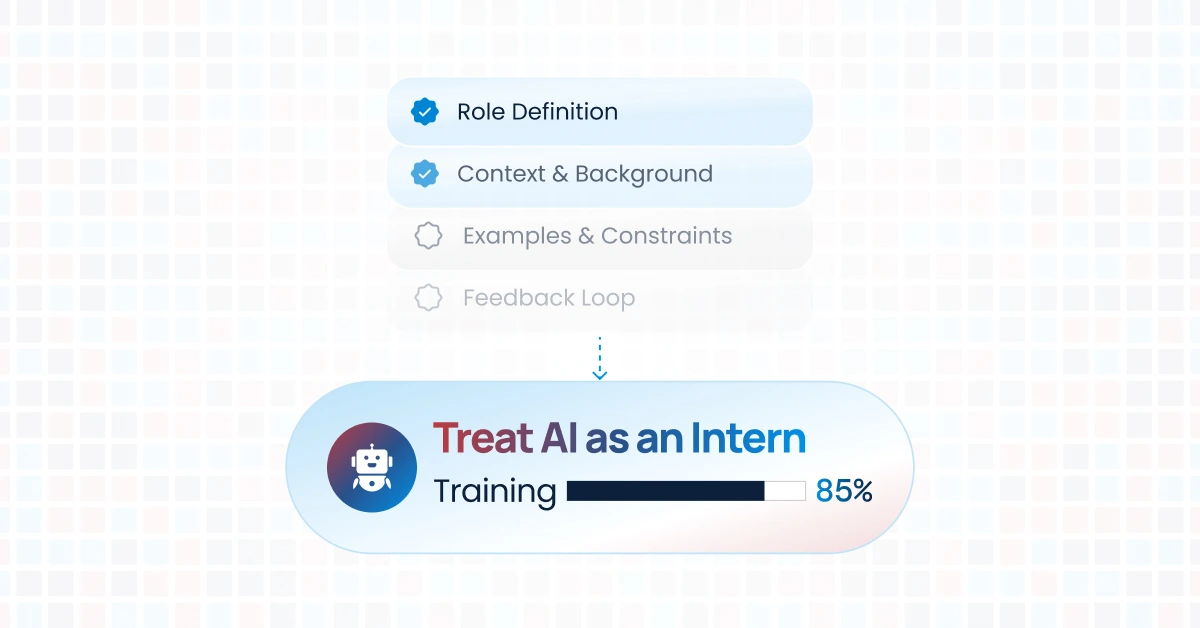
It’s a highly capable intern that needs clear instructions, examples, and feedback.
Let’s walk through the most important AI prompting techniques using this intern analogy, so you can finally get the results you expect, not just the ones you accept.
But here’s the uncomfortable truth most organizations are ignoring:
Your AI initiative will fail not because of the technology, but because of your data.
1. Role Assignment: “Who Are You in This Task?”
Intern Version
You don’t just say,
“Do this task.”
You say:
- “You’re acting as a marketing assistant.”
- “You’re helping the finance team.”
- “You’re doing legal research.”
Because the role defines:
- Their mindset
- Their vocabulary
- Their level of responsibility
AI Version (Role Prompting)
You should do the same with AI:
Weak Prompt:
Write me a contract.
Strong Prompt:
You are an experienced corporate lawyer. Draft a SaaS service agreement for a B2B startup operating in the U.S.
Why this works:
You’ve told the “intern”:
- Who they are
- How to think
- What expertise to use
This alone can improve AI output by 50–70% instantly.
2. Context Injection: “Here’s the Background You Need”
Intern Version
You never throw someone into work without explaining:
- The company
- The customer
- The goal
- The deadline
- The problem
Without context, they guess. And guessing causes mistakes.
AI Version (Context Prompting)
AI has no memory of your business unless you give it context.
Weak Prompt:
Write an email to a client.
Strong Prompt:
This email is for a healthcare SaaS client who is unhappy with delays. The goal is to rebuild trust and offer a recovery plan.
Why this works:
Context eliminates:
- Assumptions
- Generic output
- Misaligned tone
It turns AI from a guessing machine into a targeted assistant.
3. Step-By-Step Instructions: “Don’t Just Say ‘Do It’”
Intern Version
You don’t say:
“Analyze this data.”
You say:
- Clean the data
- Organize it by category
- Highlight trends
- Summarize insights
- Create a final report
That’s how clarity works.
AI Version (Chain-of-Thought Prompting)
Strong Prompt:
First analyze the problem. Then list the risks. Then propose three solutions. Finally, recommend the best one with justification.
Why this works:
AI performs significantly better when it reasons step by step, just like a human intern thinking out loud.
4. Examples: “Here’s a Sample of What ‘Good’ Looks Like”
Intern Version
Nothing teaches faster than examples.
You show:
- A good report
- A bad report
- A preferred format
AI Version (Few-Shot Prompting)
Example Prompt:
Here is an example of the style I want:
[Insert example]
Now generate a new one using the same tone and format.
Why this works:
AI mimics patterns extremely well. Examples act like training data on demand.
5. Constraints: “What NOT to Do Matters Too”
Intern Version
You tell them:
- Don’t contact the client directly
- Don’t share internal data
- Don’t exceed two pages
AI Version (Constraint Prompting)
Strong Prompt:
Keep the response under 200 words. Do not use technical jargon. Avoid legal claims.
Why this works:
Constraints:
- Prevent hallucinations
- Control verbosity
- Maintain brand safety
6. Feedback Loop: “Let Me Review and Correct You”
Intern Version
Interns improve through:
- Corrections
- Reviews
- Iterations
You don’t fire them after one mistake.
AI Version (Iterative Prompting)
AI improves when you refine:
“That’s close, but make it more persuasive.”
“Remove technical detail.”
“Make it suitable for children.”
Why this works:
Each iteration sharpens alignment—just like coaching a human.
7. Memory & Instructions at Scale: “Standard Operating Procedures”
Intern Version
Over time, you give:
- SOPs
- Playbooks
- Checklists
So they don’t need repeated training.
AI Version (System Prompts & Persistent Instructions)
In advanced systems (like AI agents), you embed:
- Rules
- Tone
- Compliance
- Behavior limits
This turns AI from:
“One-time intern”
into
“Long-term trained assistant”
Final Takeaway: AI Is Not a Mind Reader—It’s a Trainable Intern
Most people fail with AI because they treat it like magic.
Smart users treat it like a junior teammate:
- You define the role
- You explain the context
- You give step-by-step instructions
- You show examples
- You set boundaries
- You provide feedback
Do this—and AI becomes:
- Predictable
- Accurate
- Valuable
- Business-ready
Why This Matters for the Future of Work
The people who will dominate the next decade are not:
- The best coders
- The best writers
- The best designers
They will be the people who are best at instructing AI clearly.
Prompting is becoming the new management skill.
You are no longer just a worker.
You are now the manager of digital interns.
Kickstart Your AI Success Journey – Explore AI Command Center Today!
Search Blog
About us
CloudKitect revolutionizes the way technology startups adopt cloud computing by providing innovative, secure, and cost-effective turnkey AI solution that fast-tracks the digital transformation. CloudKitect offers Cloud Architect as a Service.
Related Resources

Evolution of AI [2024-2026]: From Generative Breakthroughs to Multi-Agent Orchestration
Muhammad Tahir
No Comments
Read More »
The Great Reversal: From Task Executors to Task Orchestrators
Muhammad Tahir
No Comments
Read More »