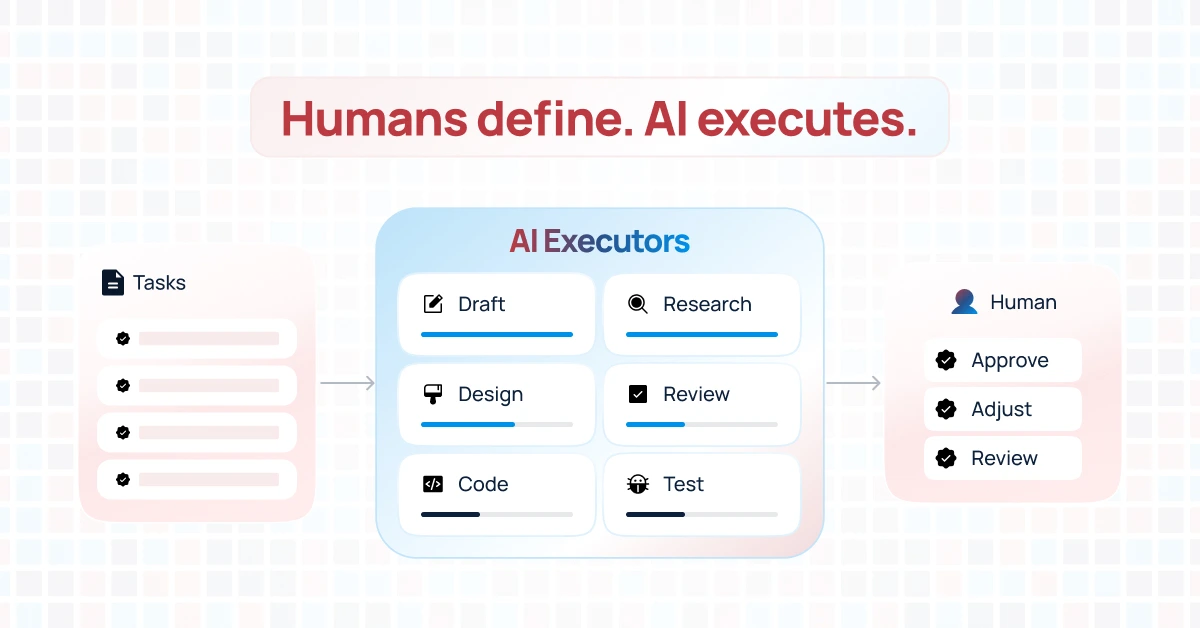

For most of human history, work has meant execution. We were the ones who typed the emails, created the spreadsheets, wrote the code, designed the graphics, and processed the invoices. Our value was measured by our ability to do things—quickly, accurately, and consistently. But something fundamental has shifted in the past few years, and we’re witnessing a transformation as significant as the Industrial Revolution’s impact on manual labor.
We’re moving from a world where humans execute tasks to one where we orchestrate them.
The Old Paradigm: Humans as Executors
Think about what a typical workday looked like just five years ago. A marketing manager would spend hours crafting social media posts, editing images, writing email campaigns, and formatting presentations. A data analyst would manually clean datasets, create visualizations, and write reports. A software developer would spend significant time on boilerplate code, debugging syntax errors, and writing documentation.
The pattern was clear: professionals were hired for their ability to execute specific tasks within their domain. You were valuable because you could do the thing—whether that thing was writing Python functions, creating pivot tables, or designing landing pages.
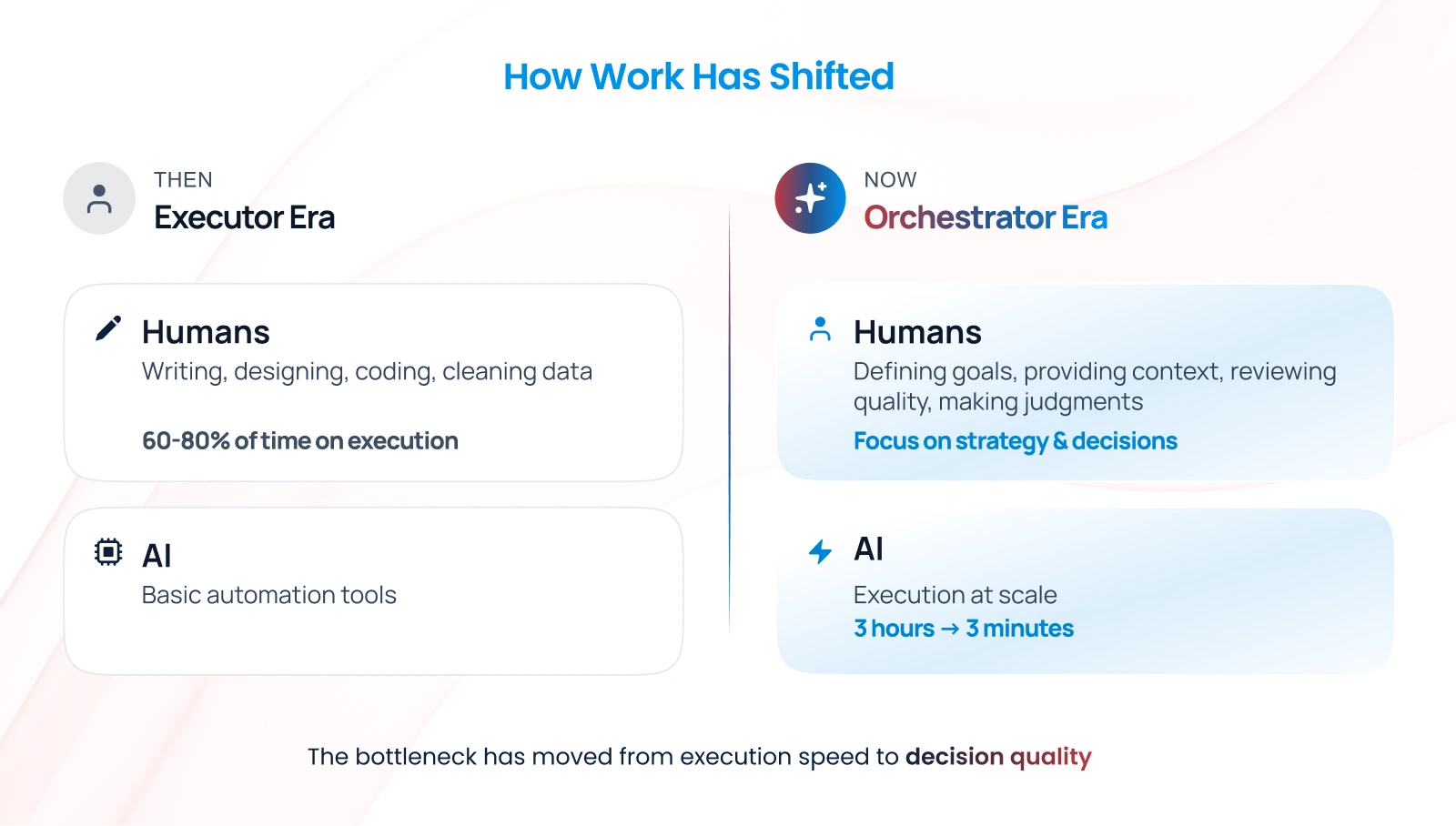
Certainly, strategic thinking was always part of professional work. But the reality was that 60-80% of most knowledge workers’ time went to execution, with only 20-40% dedicated to higher-level thinking about what should be done, why, and how to measure success.
The AI Shift: A New Division of Labor
AI hasn’t just automated some tasks—it’s fundamentally redistributed the execution burden. Modern AI tools can now:
- Write entire first drafts of articles, reports, and code
- Generate designs, images, and presentations from descriptions
- Analyze datasets and create visualizations on command
- Debug code and suggest optimizations
- Translate languages, summarize documents, and extract insights
- Handle customer inquiries and process routine requests
What’s remarkable isn’t just that AI can do these things, but how quickly and how well. A task that might have taken a human three hours can now be done in three minutes. The bottleneck has moved from execution speed to decision quality.
The Emergence of the Task Manager Role
This shift has created a new paradigm where the human’s primary value is no longer in executing tasks but in managing them. We’re becoming conductors of an orchestra where AI tools are the musicians.
Defining the Work
Instead of writing code, we now define what the code should accomplish. Instead of creating designs, we articulate the design goals, brand guidelines, and user needs. The skill shifts from “can you build this?” to “do you know what needs to be built and why?”
Quality Control
AI execution isn’t perfect. It requires human judgment to evaluate, refine, and approve. A manager reviewing an AI-generated marketing campaign needs to assess whether it captures the right tone, aligns with brand values, and will resonate with the target audience—skills that require experience, taste, and strategic understanding.
Integration and Context
AI tools don’t automatically know your company’s unique constraints, your team’s capabilities, or your industry’s unwritten rules. Humans provide the context that turns generic AI output into work that’s specifically valuable for your situation.
Ethical Oversight
Humans make judgment calls about what should be done, not just what can be done. We consider implications, unintended consequences, and ethical dimensions that AI tools don’t inherently understand.
What This Means in Practice
Let’s look at how this plays out across different roles:
Software Developers
Software Developers now spend less time writing boilerplate code and more time on system architecture, defining requirements, code review, and ensuring different components work together coherently. The question isn’t “can you write a function to sort this data?” but “what’s the right data structure for this problem, and how does it fit into our broader system?”
Content Creators
Content Creators are shifting from being writers to being editors and strategists. AI can generate multiple draft options in seconds, but humans decide which direction to pursue, what tone to strike, what stories to tell, and how to adapt content for specific audiences and contexts.
Designers
Designers are moving from pixel-pushing to creative direction. AI can generate dozens of design variations, but humans determine which designs align with brand identity, solve the user’s problem, and create the right emotional response.
Analysts
Analysts are spending less time cleaning data and creating charts, and more time asking the right questions, interpreting results in business context, and making recommendations that account for factors AI can’t see in the data.
The Skills That Matter Now
This transformation demands a different skill set:
Judgment
Judgment has become paramount. When AI can generate ten solutions in the time it used to take to create one, the ability to evaluate which solution is best becomes the critical skill.
Communication
Communication matters more than ever. You need to clearly articulate what you want to AI tools, stakeholders, and team members. Vague instructions that a human colleague might interpret correctly will lead AI astray.
Systems Thinking
Systems Thinking is essential. Understanding how different pieces fit together, anticipating downstream effects, and seeing the bigger picture separates effective AI managers from ineffective ones.
Domain Expertise
Domain Expertise hasn’t diminished—it’s more valuable. You need deep knowledge to recognize when AI output is subtly wrong, to ask the right questions, and to know what good looks like in your field.
Adaptability
Adaptability is crucial in a landscape where new AI capabilities emerge monthly. The tools you’re using today might be obsolete in six months, but the skill of learning to work with new tools compounds over time.
The Challenges of Transition
This shift isn’t painless. Many professionals built their careers on execution skills and now feel those skills being devalued. There’s a real psychological adjustment required when the work you spent years mastering can now be done by an AI in seconds.
There’s also a learning curve. Managing AI effectively is genuinely difficult. It requires understanding what AI can and can’t do, learning to prompt effectively, and developing intuition for when to trust AI output and when to second-guess it.
Organizations are struggling too. Job descriptions written for executors don’t make sense for orchestrators. Performance metrics based on output volume become meaningless when AI can 100x that output. Management structures designed around task completion need rethinking when the tasks themselves are no longer the constraining resource.
Looking Forward
We’re still in the early stages of this transition. As AI capabilities continue to expand, the line between what AI executes and what humans manage will keep shifting. Today’s management tasks might become tomorrow’s automated processes.
But rather than leading to human obsolescence, this shift is pushing us toward distinctly human work: understanding context, making nuanced judgments, navigating ambiguity, creating strategy, building relationships, and ultimately deciding what’s worth doing in the first place.
The irony is that by taking on the role of task managers rather than task executors, we’re actually becoming more human at work. We’re focusing on the things humans are uniquely good at: understanding meaning, making value judgments, and determining purpose.
The professionals who will thrive in this new landscape aren’t necessarily the ones who were the fastest executors. They’re the ones who can think clearly about what needs to be done, communicate it effectively, evaluate results critically, and make sound judgments about complex situations.
We’re not becoming obsolete. We’re becoming managers in the truest sense—not just of tasks, but of an entirely new kind of workforce where silicon and carbon collaborate in ways we’re still learning to navigate.
Kickstart Your AI Success Journey – Explore AI Command Center Today!
Search Blog
About us
CloudKitect revolutionizes the way technology startups adopt cloud computing by providing innovative, secure, and cost-effective turnkey AI solution that fast-tracks the digital transformation. CloudKitect offers Cloud Architect as a Service.
Related Resources
Evolution of AI [2024-2026]: From Generative Breakthroughs to Multi-Agent Orchestration
Muhammad Tahir
No Comments
Read More »