
Evolution of AI [2024-2026]: From Generative Breakthroughs to Multi-Agent Orchestration
- Blog
- Muhammad Tahir
The artificial intelligence landscape has undergone a remarkable transformation in just a few short years. What began as impressive demonstrations of text and image generation has evolved into sophisticated systems capable of autonomous reasoning, decision-making, and collaboration. As we stand at the threshold of 2026, the trajectory is clear: we’re moving from singular AI capabilities to coordinated multi-agent ecosystems that promise to fundamentally reshape how work gets done.
2024: The Generative AI Revolution
2024 marked the true mainstreaming of generative AI. This was the year when AI moved from research labs and early adopter experiments into everyday business operations. Organizations across industries deployed large language models for content creation, code generation, customer service, and data analysis. The technology matured from novelty to necessity.
The theme of 2024 was accessibility and adoption. Tools like ChatGPT, Claude, and GitHub Copilot became as commonplace in knowledge work as email and spreadsheets. Companies weren’t just experimenting anymore—they were integrating generative AI into their core workflows. Marketing teams used AI to draft campaigns, developers to accelerate coding, analysts to interpret complex datasets, and executives to synthesize information for strategic decisions.
What made 2024 distinctive was the focus on single-task excellence. These AI systems excelled at discrete activities: write this article, generate that image, summarize this document, debug that code. The human remained firmly in the driver’s seat, directing each action and stitching together the outputs into coherent outcomes.
2025: The Rise of AI Agents
If 2024 was about AI as a tool, 2025 was about AI as a colleague. This year witnessed the emergence of agentic AI—systems capable of pursuing goals across multiple steps with minimal human intervention. Rather than simply responding to prompts, these agents could understand objectives, devise plans, take actions, and adapt based on results.
The shift was profound. An AI agent tasked with “research our top three competitors” wouldn’t just wait for follow-up instructions. It would autonomously search the web, compile relevant information, analyze strengths and weaknesses, and deliver a comprehensive report—all from a single high-level directive. Agents could navigate software interfaces, call APIs, query databases, and chain together dozens of actions to accomplish complex objectives.
Companies like Anthropic introduced computer use capabilities, allowing Claude to control computers as humans do. OpenAI launched agents that could operate autonomously for extended periods. Startups built specialized agents for specific domains—recruiting, customer success, financial analysis, software testing.
The practical implications became apparent quickly. Tasks that previously required hours of human effort—data entry, report generation, competitive intelligence gathering, preliminary code reviews—could now be delegated entirely to AI agents. The bottleneck shifted from execution to direction: humans spent less time doing and more time deciding what should be done.
2026: The Multi-Agent Future
As we look toward 2026, the signals are unmistakable: this will be the year of multi-agent orchestration. The industry is moving beyond asking “what can an AI agent do?” to “what can a team of AI agents accomplish together?”
Several converging trends point toward this evolution. First, AI models continue improving at specialized tasks. Rather than pursuing a single “super agent” that does everything adequately, we’re seeing proliferation of focused agents that excel in specific domains—legal research, code testing, data visualization, copywriting, and so on.
Second, the tooling for agent coordination is maturing rapidly. Frameworks for agent communication, shared memory, task delegation, and workflow orchestration are becoming sophisticated and accessible.
Third, organizations are recognizing that multi-agent systems more closely mirror how humans actually work. We don’t assign one person to handle every aspect of a complex project. We assemble teams with complementary skills, clear roles, and collaborative processes. Multi-agent AI simply extends this proven model.
The implications are substantial. Imagine a content marketing operation where a research agent gathers market intelligence, a strategy agent defines messaging and positioning, a writing agent drafts content, a design agent creates accompanying visuals, an SEO agent optimizes for search, and an analytics agent measures performance—all working in concert under human direction but without requiring human involvement in every handoff.
Or consider software development where a requirements agent translates business needs into technical specifications, an architecture agent designs system components, multiple coding agents implement features in parallel, a testing agent validates functionality, a security agent identifies vulnerabilities, and a documentation agent maintains current technical references. The entire development lifecycle becomes a choreographed multi-agent workflow.
CloudKitect's 2025 Journey: When One Agent Isn't Enough
CloudKitect’s experience in 2025 perfectly illustrated both the promise and the limitations of single-agent AI. While individual agents proved remarkably capable, the company’s most complex challenges revealed a fundamental truth: the most valuable work rarely fits into a single agent’s scope.
We found that the pattern—plan, distribute, execute, evaluate—emerged organically across CloudKitect’s 2025 projects. The solutions we built for our customers consistently involved orchestrated multi-agent workflows rather than monolithic single agents.
CloudKitect's Vision: Humans Manage, AI Executes
CloudKitect’s positioning for 2026 reflects this multi-agent future: augmenting the workforce with AI counterparts where humans manage and AI executes. This isn’t about replacement but about fundamental role transformation.
In this model, human expertise shifts from hands-on execution to higher-order functions: setting strategic direction, making judgment calls that require nuanced understanding of business context, navigating ambiguous situations where there’s no clear right answer, building relationships with clients and stakeholders, and orchestrating AI teams to achieve complex objectives.
The AI workforce handles execution at scale. Multiple specialized agents collaborate on projects, each contributing their particular strengths. They work tirelessly, consistently, and without the context-switching costs that hamper human productivity. They handle the routine, the repetitive, and the rigorously defined, freeing humans to focus on the creative, the strategic, and the interpersonal.
This partnership model addresses several critical challenges. It solves the talent shortage by multiplying the effective capacity of skilled professionals. A senior cloud architect can now oversee dozens of simultaneous projects by directing agent teams, rather than being limited to the few they can personally execute. It improves quality through consistent application of best practices—agents don’t cut corners when tired or skip validation steps when rushed. And it accelerates delivery by parallelizing work that would otherwise proceed sequentially.
What 2026 Holds for Agentic AI
Looking ahead to the remainder of 2026, several developments seem probable in the agentic AI space.
Specialization will deepen. We’ll see agents purpose-built for increasingly narrow domains—not just “a coding agent” but “a Python microservices debugging agent” or “a React component optimization agent.” This specialization enables superhuman performance in specific contexts.
Coordination mechanisms will become more sophisticated. Early multi-agent systems rely on relatively simple orchestration—sequential handoffs, parallel execution with merging, hierarchical delegation. We’ll see emergence of more organic collaboration patterns: agents negotiating approaches, forming temporary coalitions for subtasks, and even developing emergent workflows not explicitly programmed.
Human-AI interfaces will evolve. Managing an AI team requires different skills than using a single AI assistant. We’ll see new tools and techniques for expressing intent to agent teams, monitoring their progress, intervening when needed, and evaluating their output. The role of “AI team lead” will emerge as a distinct professional skillset.
Trust and verification frameworks will mature. As agent decisions carry greater consequences, mechanisms for ensuring reliability become critical. Expect advances in agent explainability, audit trails, confidence calibration, and built-in verification steps that make AI teams trustworthy for high-stakes applications.
Economic models will shift. Organizations currently budget for AI based on API calls or seat licenses. Multi-agent workflows will drive new pricing models based on outcomes delivered, complexity handled, or capacity augmented. The value proposition shifts from “how much does this AI cost?” to “how much human work does this AI team replace?”
The most profound shift may be psychological. We’re moving from thinking about AI as software to thinking about AI as workforce. This changes how we organize work, measure productivity, develop talent strategies, and conceive of our organizations’ capabilities.
The Road Ahead
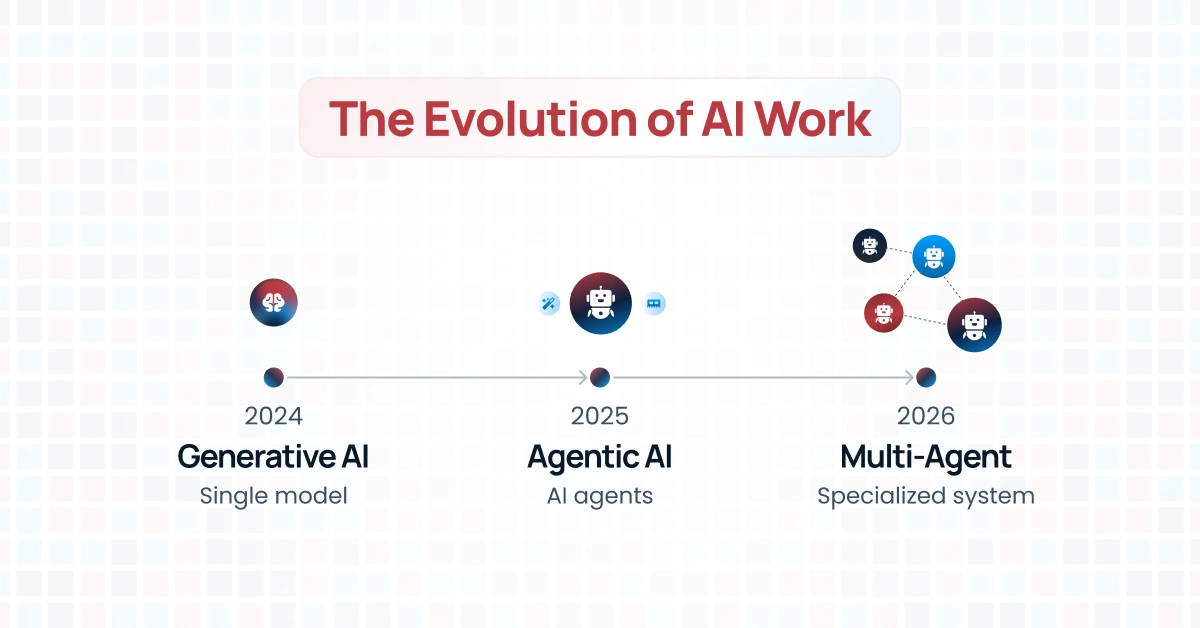
The trajectory from 2024’s generative AI breakthrough through 2025’s agentic capabilities to 2026’s multi-agent orchestration represents more than technological evolution. It reflects a fundamental reimagining of the relationship between human and artificial intelligence.
We’re entering an era where the limiting factor in knowledge work isn’t access to information, computational power, or even AI capabilities—it’s human strategic thinking and judgment. The organizations that thrive will be those that master the art of directing AI teams toward valuable outcomes, maintaining the irreplaceable human elements of creativity and wisdom while leveraging AI’s scalability and consistency.
CloudKitect’s journey from experimenting with single agents to deploying coordinated multi-agent workflows mirrors the broader industry trajectory. The future they’re building—where skilled professionals manage AI counterparts that handle execution—offers a glimpse of how work itself is transforming.
As we progress through 2026, one thing seems certain: the question won’t be whether to adopt multi-agent AI, but how quickly we can develop the organizational capabilities to harness its potential. The agentic AI space is moving from proof of concept to production deployment, from curiosity to competitive necessity. Those who adapt quickly will find themselves with capabilities that seemed like science fiction just years ago. Those who hesitate may discover they’re competing against organizations effectively multiplied by AI.
The future of work isn’t humans or AI. It’s humans and AI, working together in ways we’re only beginning to imagine.
Kickstart Your AI Success Journey – Explore AI Command Center Today!
Search Blog
About us
CloudKitect revolutionizes the way technology startups adopt cloud computing by providing innovative, secure, and cost-effective turnkey AI solution that fast-tracks the digital transformation. CloudKitect offers Cloud Architect as a Service.
Related Resources
The Great Reversal: From Task Executors to Task Orchestrators
Muhammad Tahir
No Comments
Read More »